Artech

Blog

  • Comment expliquer des concepts techniques à un public non technique

    Comment expliquer des concepts techniques à un public non technique

    How to Communicate Tech Concepts to a Non-Technical Audience Effectively

    Que cela vous plaise ou non, les techniciens passent de plus en plus de l’arrière-plan aux premières lignes. Vous vous retrouvez souvent face à des publics non techniques – clients, membres de la direction, finance, équipes transversales et autres parties prenantes – et devez expliquer des concepts techniques de manière simple.

    Besoin d’un coup de main ? Voici six stratégies éprouvées pour communiquer efficacement des concepts techniques à un public non technique.

    • Établissez la pertinence dès le départ

      Votre audience sera beaucoup plus réceptive si elle comprend l’impact de l’information pour elle. Bien sûr, vous voulez expliquer la feuille de route du processus, mais il peut être judicieux de commencer par expliquer l’objectif final.

      La préparation est essentielle ici. Faites vos recherches pour comprendre quelles informations seront pertinentes pour l’audience, puis concevez votre présentation pour répondre dès le début à la question « qu’est-ce que ça m’apporte ? ».

    • Évitez la surcharge d’information

      Même si vous avez beaucoup d’informations à partager, inonder l’audience de détails n’aide pas.

      Soyez sélectif et réduisez le contenu. Concentrez-vous sur l’essentiel pour votre audience. Anticipez les questions qu’ils pourraient poser et restez focalisé sur les points les plus importants et pertinents.

      Par exemple, si on vous demande d’évaluer un outil de cybersécurité par rapport à un autre en un temps limité, ne comparez pas la technologie sous-jacente, mais expliquez comment ces outils se traduisent en ROI, atténuation des risques et fonctionnalités.

    • Racontez une histoire

      Tout le monde aime une bonne histoire. Construisez-en une autour de votre message. Ne vous contentez pas de faire une présentation ; emmenez l’audience dans un voyage. Pour chaque diapositive, voyez comment elle fait avancer le récit global de la présentation.

      Incorporez des anecdotes personnelles, des exemples et des analogies pour illustrer vos propos. Si vous n’avez pas d’histoire personnelle pertinente, recherchez des événements relatables pour renforcer votre argumentation.

    • Évitez le jargon

      Les termes techniques et abréviations que vous maîtrisez sont étrangers à votre audience. Il faut abandonner le jargon.

      Parsemer votre discours de termes techniques peut entraîner désintérêt et désengagement. Simplifiez et expliquez les concepts autant que possible.

      Si beaucoup de détails sont nécessaires, ou si vous doutez du niveau technique de l’audience, envisagez de distribuer un petit glossaire avant la présentation.

    • Utilisez des supports visuels

      Pourquoi perdre la moitié de la réunion à expliquer un point quand quelques images peuvent l’illustrer plus rapidement ?

      Le contenu visuel est très efficace pour communiquer des processus et concepts techniques. Selon des études, 65 % des personnes apprennent mieux visuellement. Les supports visuels sont donc précieux pour aider un public non technique à comprendre.

      Utilisez des diagrammes, des modèles et d’autres techniques visuelles pour renforcer votre message.

    • Demandez des retours et invitez aux questions

      La communication est un échange à double sens. En plus de transmettre votre message, observez la réaction de l’audience. Ont-ils des questions ? Suivent-ils le rythme ? Soyez attentif aux signaux implicites et sollicitez un feedback explicite.

      Prenez des pauses fréquentes pour inviter aux questions et clarifier les points. Respectez le niveau technique de votre public.

  • How to Explain Technical Concepts to a Non-Technical Audience

    How to Explain Technical Concepts to a Non-Technical Audience

    How to Communicate Tech Concepts to a Non-Technical Audience Effectively

    Like it or not, techies are getting pushed out from the backroom to the front lines. Increasingly, you find yourself standing in front of non-technical audiences – customers, C-suite members, finance, cross-functional team members, and other stakeholders – expected to explain tech concepts in simple terms.

    Need some help? Here are six proven strategies you can use to communicate tech concepts to a non-technical audience effectively.

    • Establish relevance upfront

      Your audience will be much more receptive to your information if they understand how it will impact them. Sure, you want to explain the process roadmap, but it may be a good idea to begin by explaining the point of arrival.

      Preparation is the key here. Do your homework beforehand to understand what will be considered relevant information by the audience, and then craft your presentation to address the what’s-in-it-for-me question upfront and early on in the interaction.

    • Avoid information overload

      While you may have a lot of information to share, cramming every detail down the audience’s throat will not help.

      Be selective and keep paring the content. Consider what is essential to the audience. Try and anticipate the questions they will ask. And then, remember to stay focused on the most important and relevant points during the discussion.

      Been asked to assess one cybersecurity tool against another in a limited time? Instead of contrasting the technology that powers the tools, focus on how the tools will translate into ROI, risk mitigation, and functionality.

    • Tell a Story

      Everyone loves a good story. So, weave one around your message. Don’t just make a presentation; take the audience on a journey. When planning each slide, see how it will push the presentation’s overall narrative forward.

      Incorporate personal anecdotes, examples, and analogies to make your point. If you don’t have any personal stories that relate to the situation, research. Use relatable events to make your case.

    • Junk the Jargon

      The abbreviated terms and domain-specific terminologies that are a second language for you are alien to your audience. You need to ditch the jargon.

      Peppering the conversation with lots of technical terms may lead to audience disinterest and disengagement. Instead, try to simplify and explain concepts as much as possible.

      If a lot of detail is required, and/or you are unsure about the audience’s technical expertise, distributing a jargon cheat sheet before getting into the presentation/interaction may be a good idea.

    • Use visuals aids

      Why waste half the meeting trying to explain a point when a few pictures can illustrate the point much more quickly.

      Visual content is highly effective in communicating technical processes and concepts. As per studies, 65% of people are visual learners. Therefore, visual aids are valuable for helping non-technical audiences understand technical concepts.

      Do leverage diagrams, models, and other visual presentation techniques to
      drive home your point.

    • Ask for feedback, invite questions

      Communication is a two-way street. Along with saying your piece, focus on the audience’s response. Do your listeners have any questions? Are they seem to be following your pace? Look out for implicit cues and seek explicit feedback as well.

      Take frequent breaks to invite questions and clarify points. Be respectful of the audience’s technical knowledge limitations.

  • Comment lutter contre l’âgisme dans le secteur technologique

    Comment lutter contre l’âgisme dans le secteur technologique

    Ageism in Tech Industry

    « Les jeunes sont tout simplement plus intelligents ! »

    Vous vous souvenez de ce commentaire célèbre de Mark Zuckerberg ?

    Le PDG de Facebook de l’époque avait fait cette remarque lors d’un événement à Stanford en 2007. Et bien que le PDG de Meta (38 ans aujourd’hui) ait peut-être changé d’avis depuis, l’attitude âgiste reflétée dans cette déclaration reste présente dans de nombreux segments de l’industrie technologique encore aujourd’hui.

    Il est regrettable de constater que, malgré la pénurie de talents et l’accent persistant sur la diversité, l’équité et l’inclusion pour élargir le vivier de compétences, les employés plus âgés font souvent encore face à des préjugés négatifs.

    De plus, l’âge considéré comme « trop vieux » dans la tech est beaucoup plus jeune que dans d’autres secteurs.

    Une étude récente de CWJobs a révélé que le travailleur technologique moyen au Royaume-Uni commence à subir de la discrimination liée à l’âge dès 29 ans. Ses collègues le considèrent comme « dépassé » à 38 ans, 35 % se sentant alors jugés trop vieux pour leur poste et 32 % craignant de perdre leur emploi. Une recherche similaire menée par une université suédoise fixe l’âge « trop vieux » à 35 ans. Les enquêtes montrent également que plus de 40 % des employés technologiques considérés comme trop âgés ont été témoins ou victimes de discrimination liée à l’âge.

    Avez-vous déjà été confronté à ce type de discrimination ? Si oui, voici cinq stratégies précieuses pour y faire face :

    1. Comprenez que vous êtes précieux

      L’âgisme ne conduit pas seulement à une discrimination directe, mais peut aussi entraîner une sous-performance des employés plus âgés. Les experts notent qu’une exposition constante aux préjugés négatifs peut rendre les travailleurs anxieux, les empêchant de se concentrer et de performer de manière optimale. Un cercle vicieux se crée, transformant le stéréotype négatif en prophétie auto-réalisatrice.

      Protégez-vous consciemment contre cette négativité.

      Vous êtes un professionnel actif, pas un poids. Votre expérience vous a doté d’un savoir pratique que les débutants ne peuvent égaler.

      Au fil des ans, vous avez exploré plusieurs concepts et domaines, devenant ainsi une personne multi-compétente capable d’acquérir rapidement de nouvelles compétences. Avec l’accent actuel sur la mobilité interne, cela fait de vous un atout inestimable pour l’organisation.

      Vous avez également une valeur énorme en tant que mentor potentiel pour guider les nouveaux arrivants dans les méandres organisationnels.

    2. Cultivez un esprit de débutant

      Les nouvelles recrues ont un énorme avantage : un esprit de débutant.

      Concept zen, l’esprit de débutant désigne notre état d’esprit unique face à quelque chose de nouveau. Nous abordons le concept avec curiosité et enthousiasme, sans attentes ni idées préconçues. Nous sommes ouverts aux possibilités et à l’apprentissage.

      Le paradoxe est que plus nous connaissons un sujet, plus nous risquons de fermer notre esprit à de nouveaux apprentissages (le piège du « je sais tout »).

      Évitez ce piège et cultivez un esprit de débutant. Posez des questions, restez curieux et surtout, demeurez humble intellectuellement. Certes, vous savez beaucoup, mais il reste énormément à apprendre. Et peut-être que c’est le plus jeune dans la salle qui pourra vous enseigner quelque chose.

      Enfin, l’expérience est précieuse, mais elle ne doit pas freiner l’apprentissage futur.

    3. Spécialisez-vous et restez à jour

      Un solide ensemble de compétences est votre meilleure protection contre l’âgisme. Restez au fait des innovations et des évolutions dans votre domaine. Optez pour la formation croisée, abonnez-vous à des blogs ou podcasts et réservez du temps pour développer vos compétences… Pour rester pertinent, vous devez rester à jour.

      Bien sûr, cela ne signifie pas que vous devez tout suivre et lutter constamment pour rester à niveau. Une meilleure stratégie consiste à choisir un domaine de spécialisation et à acquérir une connaissance approfondie. En devenant expert, non seulement votre valeur pour l’organisation augmente, mais votre crédibilité professionnelle aussi.

    4. Réseauter pour progresser

      Vous êtes dans l’industrie depuis un certain temps ; profitez de vos contacts. Bénéficiez de leurs perspectives, comprenez les exigences changeantes, identifiez les points sensibles de l’entreprise et évaluez si vous devez acquérir de nouvelles compétences pour rester pertinent.

      Votre réseau peut vous aider à trouver de nouvelles opportunités et à obtenir du parrainage. Souvent, à mesure que vous progressez, les références deviennent aussi importantes que le CV. Vos contacts peuvent s’avérer précieux.

    5. Dénoncez-le

      Bien que l’industrie prenne conscience qu’elle ne peut se permettre de discriminer une population formée et expérimentée, en tant qu’employé plus âgé, vous devez également vous protéger contre l’âgisme.

      Ainsi, si vous êtes confronté à de l’âgisme, qu’il soit intentionnel ou non, n’hésitez pas à le dénoncer.

    Les recherches indiquent que la plupart d’entre nous travailleront plus longtemps que les générations précédentes. Transformez votre âge en atout en appliquant les stratégies présentées ici.

  • How to Tackle Ageism in the Tech Industry

    How to Tackle Ageism in the Tech Industry

    Ageism in Tech Industry

    Young people are just smarter!”

    Remember the notorious comment made by Mark Zuckerberg?

    The then-Facebook CEO had made this comment at a Stanford event in 2007. And while the Meta CEO (38 years old now) may have had a change of heart since, the ageist attitude reflected in the statement holds sway in many segments of the tech industry even today.

    It is unfortunate to see that despite the spectre of talent shortages and the persistent focus on diversity, equity, and inclusion to widen the skill pool, older employees often still face a negative bias.

    Also, the age considered ‘too old’ in tech is far younger than other industries’ standards.

    A recent study by CWJobs revealed that the average UK tech worker starts experiencing age discrimination as early as 29. Colleagues consider them ‘over the hill’ by the time they hit 38, leaving 35% feeling that they are classed as too old for their role and 32% afraid of losing their job. Similar research by a Sweden university puts the too-old age at 35 years. And surveys show that over 40% of tech employees considered overage have witnessed or undergone age discrimination.

    Have you ever been at the receiving end of this age discrimination? If so, here are five valuable strategies you can use to deal with the situation.

    1. Understand you are valuable

      Ageism does not only result in direct discrimination, but it can also result in older employee underperformance. Experts note that constant exposure to negative bias can make older workers anxious. They cannot focus and perform optimally. A vicious spiral gets created, making the negative age stereotype a self-fulfilling phenomenon.

      Guard against this negativity consciously.

      You are a working professional, not a liability. Your experience in the field has equipped you with a level of practical knowledge that rookies can’t compete with.

      You have had exposure to multiple concepts and fields over the years, making you a multi-skilled person who can quickly build on prior knowledge to pick up new skill sets. Given the focus on inward mobility today, this makes you an invaluable asset to an organization.

      You also hold immense value as a potential mentor who can guide newcomers trying to navigate the organizational mazes.

    2. Cultivate a beginner’s mind

      Fresh recruits have one huge advantage – a beginner’s mind.

      A Zen concept, the beginner’s mind refers to our unique mindset when we approach something new. We are curious about the concept and approach it eagerly. No expectations, preconceived notions, or past experiences to limit our view. We are open to possibilities and knowledge.

      However, the paradox is that the more we know about a subject, the more likely we are to close our minds to further learning. (The I-know-it-all trap.)

      Ensure that you ditch the trap and cultivate a beginner’s mind. Ask questions, stay curious, and most importantly, stay intellectually humble. Sure, you know a lot, but there is a lot more you need to learn. And maybe it is the youngster in the room who can teach it to you.

      Also, while experience is valuable, don’t let it hinder future learning.

    3. Specialize, stay updated

      A strong skillset is your best shield against ageism. Stay ahead of the innovations and changes in your field. Opt for cross-training, subscribe to blogs/podcasts, and set aside dedicated time for upskilling … To stay relevant, you need to stay updated.

      Of course, this does not mean you must stay on top of everything and struggle continuously to keep up. A better strategy is to pick an area of specialization and gain deep domain knowledge. As you become an expert in the area, not only does your value to the organization rises, street cred soars too.

    4. Network to get ahead

      You have been in the industry for a while now; leverage your connections. Tap into their perspectives. Understand changing requirements, figure out the company’s pain points and assess whether you need to upskill to stay relevant.

      Your network can help you find new opportunities and obtain sponsorships as well. Often, as you rise through the ranks, references become as essential as the resume. Your connections can come in handy here

    5. Call it out

      While the industry is waking up to the fact that they cannot afford to discriminate against an expertly trained demographic with vast experience and practical knowledge, as an older employee, you need to safeguard yourself against ageism too.

      So, if you encounter ageism, intended or unintended, call it out.

    Research indicates that most of us will be working longer than earlier generations. Turn your age into an asset by using the strategies outlined here.

  • Internal Mobility : Career Resilience in Recessionary Times

    Internal Mobility : Career Resilience in Recessionary Times

    Leverage Internal Mobility

    They are calling it a white-collar recession!

    As 2023 kicks in with a somewhat gloomy economic outlook, with predictions ranging from all-out recession to temporary downturn, analysts say that it is the white-collar jobs that stand most at risk this time around.

    The trend started in the second half of 2022 (yes, the Big Tech firing bloodbath). And the layoff waves just keep rolling in, with managers and professionals in the crosshairs of companies seeking to cut costs.

    Not the ideal backdrop for your career progression plans, we agree.

    But even though the mad job-hopping and astronomic jumps of 2021 are fading out, there are still ways to improve your career prospects.

    One of the hottest options to consider here is internal mobility – moving to a new position within the same organization.

    Leverage internal mobility along with the willingness to view career progression as a lattice rather than a ladder, and dear techie you are likely to find opportunities for growth and development even during these recessionary times.

    Internal Mobility Viewed from the Employee Lens

    Internal mobility has been headlining as a top strategy for organizations for a while now.

    Research indicates that if current employees are encouraged and given the opportunity and training to pursue a new role, maybe even a new career path, within the organization, they are likely to perform better than any external hire.

    Companies, therefore, are increasingly relying on internal mobility to overcome the dual challenge of talent squeeze and contracting staff budgets that they face today.

    Gartner’s 9 Future of Work Trends in 2023 unequivocally states that going ahead, there will be a new focus on internal talent mobility to ensure employees are deployed to the priorities that matter most and the opportunities that engage them best without fluctuations in headcount.

    How does this organizational focus on internal mobility play out for you, the employee?

    Well, in a nutshell, it makes it a lot easier for you to move ahead on the career path vertically or laterally within the organization itself rather than seek external employment.

    A well-planned internal move can:

    • Provide you opportunities for growth and development

      Moving to a new role within the same organization allows you to gain new skills and experience, making you more valuable as an employee and increasing your chances of career advancement. (And lifelong learning and upskilling, you must have heard the buzz, are the only way to stay relevant today.
    • Increase your job security

      During a recession, companies may be more likely to lay off or let go of employees in certain roles or departments. By moving to a different position within the same organization, you can reduce your risk of being affected by these changes.
    • Helps you gain a new perspective

      Taking on a new role within the same organization can give you a chance to see the company from a different perspective and potentially open up new opportunities for advancement.
    • Be a cost-effective way to advance your career

      Pursuing external job opportunities can be costly, both in terms of time and money spent on applications and interviews. Inward mobility allows you to take advantage of opportunities for career advancement without incurring these costs.

    The perceived downside here is that moving internally may not come with a big pay raise.

    When you move laterally, you may not be able to go in at the same level, which could impact your compensation. And even a vertical internal move may not be as heavily compensated as an external position.

    Also, often, people are apprehensive that staying with the same company may be viewed as career stagnation.

    However, if you like your company culture and the people you work with, the benefits of internal mobility far outweigh the negatives, especially in these recessionary times.


    How to Move Internally within the Company

    Do you remember your last job hunt – the effort you had to put in? An internal move, as mentioned earlier, is considerably simpler. However, you still need a carefully crafted strategy to ensure that you can identify and snag relevant internal opportunities.

    This article outlines a four-step process you can use to navigate your internal move.

    Step 1: Identify the ideal move: Up, down, or sideways

    Often, when envisaging our progression in the organization, we get stuck in the career ladder mental mode.

    Break the trap.

    Yes, your career could progress vertically. However, it could also move diagonally, horizontally, or even in a zig-zag fashion.

    It is a lattice, not a ladder out there, and you need to assess which move – up, down, or sideways – would suit you the best.

    As in most such situations, the assessment exercise begins with defining your goals and priorities. Why are you contemplating a move? What are you hoping to achieve via the switch?

    Job Satisfaction Questionnaire to Assess Your Career Happiness. Ask yourself:

    • Do you enjoy the field of work you are engaged in?
    • Do you want to expand your current work scope?
    • Can you bring more to the table?
    • Are you ready for higher responsibility?
    • Do you want a raise?
    • Do you want more influence?
    • Can you commit more to the job?

    If most answers are yes, you are probably ready for a vertical move.

    And if not?

    Well, then, you may want to consider a lateral move.

    A lateral move is when an individual moves from one position to another with little change in salary, title, or level.

    Even though is no promotion, a lateral move is a good option for those seeking to make a career shift and/or gain new skills and experiences. (research shows that 61% of US job seekers want to make a career change into a new field.)

    The question set that you need to consider before making a lateral move is:

    • Are you feeling stagnant in your current role?
    • Does the lateral switch help you build new skills and/or fill professional development gaps?
    • Will you be able to progress your career faster after you learn these new skills/fill the gaps?
    • Do your future career goals require cross-functional exposure, and will the lateral switch provide this experience?
    • Do you want a break from your current team?
    • Are there any personal goals – work-life balance, geographic relocation – that will be better served by the move? How important are these goals?

    Again, if the majority of the answers are yes, you may be well-served by moving laterally.

    However, do keep in mind that lateral moves involve an opportunity cost.

    Learning new skills and starting over again requires effort. Also, the shift in the career path interrupts the depth of expertise and track record you have been building.

    Also, in case you have already made several other lateral moves earlier, it may raise some red flags.

    Is the opportunity cost worth the gains you expect from the switch?

    And then there is down-shifting, the most daunting change to make. A downward move is indicated if your current career is just not in alignment with your goals (personal and/or professional).

    Consider the example of a senior backend developer who has been appointed as the team lead. A few months into the role, the developer realizes that she does not enjoy the mentoring and leadership part of the position. She would rather spend her effort building deeper technical knowledge. A step back here may be the right professional move for her.

    Stepping back and restarting can also be useful if you want to make a drastic switch in your field of work.

    A data analyst may want to shift to a data scientist position in the organization. Even though they complete the necessary upskilling for the transition, they may have to start in a relatively junior position. However, if the analyst is passionate about becoming a data scientist, the downshift should not hold them back.

    Of course, you need to weigh in personal goals and limitations and financial considerations too when assessing your ideal career move.

    You may find yourself struggling with a mix of motivators (and limitations) at the end of the assessment exercise.

    List them honestly and rank them in order of priority to figure out your ideal move.

    Step 2: Take Inventory: Think Transferable Skills

    Next, you want to revisit your resume.

    The usual tendency here is to focus on deep skills. Backend specialist – 15+ years Java experience, Lead DevOps engineer – skilled in building and maintaining SaaS solutions based on Linux/Unix platform in a cloud (AWS) …

    A better idea, though, is to think in terms of transferable skills, especially if you are considering a role change.

    Transferable skills are the skills you’ve picked up from your past experiences that can be applied to the new role you are looking to transition into. They include both technical and power skills (the new, and more apt, name for the erstwhile soft skills).

    On the technical skills front, techies are often categorized as I, T, π, M, and even comb-shaped people on basis of their specialization repertoire.

    A T-shaped techie would be someone who specializes in one area and has some basic skills and experiences in other areas. The π would have two areas of specialization, less deep though, and the comb (you guessed it) would have the breadth of a generalist and some depth in multiple fields.

    Phew!

    The problem with this approach is that tech is constantly evolving, and there is just no point viewing your knowledge trajectory only in terms of current specializations and relevant experience.

    Dave Rooney, veteran agile coach, gives a better analogy to assess your technical skills – icicle-shaped people.

    Over time you have developed a broad range of skills, but not with equal depth. Some skills you used earlier might have nearly melted away and become a shorter icicle. While others, relatively recent, may still be hanging long.

    The point is that when considering a move, you should consider the entire skill set on the icicle. It doesn’t matter if the role requires a skill that has melted away. Even if you have some knowledge of the skill (or related skills), you can build on the base and perform effectively.

    The good news is that organizations recognize this. They understand that the only way to future-proof the organization is to invest in employees who display the aptitude to learn and keep moving forward.

    As for power skills, you already know that qualities such as critical thinking, problem-solving, creativity, communication, leadership, and collaboration are in massive demand in the workplace today. (Also read The 3 Underrated Skills That Can Take Your IT Career to the Next Level)

    So, look back. Identify and articulate the skills you use to perform workplace functions and responsibilities. Are they transferable to the new role you are gunning for?

    Showcasing your functional and your non-functional transferable skills makes you a strong contender for the position you want.

    Please link  this to our internal article on underrated skills

    Step 3: Build the Base: Manifest (And Discuss) Your Passion

    What’s it gonna take?

    This is the part where you actually start working towards your target.

    The first, and most obvious step, here is skill gap analysis. What is your current skill set, and what is the required skill set for the job you want? (Don’t forget Step 2, transferable skills count).

    If any critical skills are missing, how do you plan to acquire them? Online courses, volunteering, working with a mentor, side-projects, seeking involvement in initiatives in the function you want to join … there are multiple routes to consider here.

    Now, once you have identified the gaps and are working towards filling them, you may feel you have done your bit.

    Right?

    Wrong.

    There is another side to the equation.

    You need to make your passion known.

    Bring up the career path you want to pursue, early and often, in discussions with your boss and/or HR. Performance reviews and one-to-one meetings with the boss/HR provide an excellent window.

    Seek active feedback – courses to pursue, attitudes to be cultivated, cross-functional experience opportunities – on what you need to do to get to the point you want to achieve during the review.

    Even if direct guidance is unavailable, the organization will take note (and hopefully) appreciate that you are an engaged employee proactively seeking professional development and upskilling.

    You would do well to cultivate a robust cross-departmental network too. It will provide visibility into areas of the business that are removed from you.

    A broad-spread network of influential allies, sponsors, and mentors, when informed about your career progression aspirations, can help you sniff out potential opportunities available within the organization well ahead of time.

    Also, do keep your allies updated about your achievements and skills. No, you don’t need to blow the bugle, but a little humble bragging about your success stories and relevant experience provides them with the ammunition to pitch for you when required.

    Step 4: Reach: Ability > Qualification

    And then you reach.

    Scout for open positions in the organization. The company job portal is the usual starting point, but you could approach departments/people you want to work with directly too.

    In case you’re in a traditional, hierarchical organization, don’t hesitate to step out and advocate for yourself.

    Be proactive, and communicate clearly what you are looking for and why you think you would be a good fit for the role when you reach out.

    Also, and this one is important, don’t let self-limiting thoughts and doubts hold you back from applying to the position you want.

    Often, a confidence gap of actual or perceived barriers deters us from pursuing opportunities that excite us.

    I don’t have the right experience. My expertise lies in a different area. My degree does not cover this. There are far better-qualified candidates for the job …

    This professional confidence gap is especially pronounced for women. A 2014 Hewlett Packard study indicates that men apply for a job when they meet only 60% of the qualifications, but women apply only if they meet 100% of them.

    The situation continues even today.

    Push yourself out of this thought pattern.

    Understand that as an internal candidate, you already have a solid in. No automated application system and algorithms screening you out here.

    The company knows you. It has invested in you and wants to retain you.

    Even if your skillset and qualifications are not the perfect fit for the role, your experience and internal performance record (we are hoping it is a good one) make you a strong contender for the position.

    The fact is that quality talent is short, and companies realize that it is imperative to provide their employees with personalized career pathways based on goals and interest areas to retain them.

    Also, if you are unsure whether you meet the requirements for the hot, new post that has just opened up, remember chances are that other candidates too are unlikely to be equipped with all the skills that the role demands.

    The fact is that there is a structural gap in the tech talent market. Organizations are remodeling themselves to leverage new, emerging technologies. However, the specialized skills required to implement the latest tech tools are scarce.

    Therefore, companies are increasingly relying on upskilling and retraining to equip the current workforce to take on new roles, and herein lies your window of opportunity.

    And what if the domain you want to pursue does not align with your college education?

    Take heart! According to Harvard Business Review research, companies are already ditching degree requirements for 31 percent of high-skill and 46 percent of middle-skill positions.

    Ability to perform the role – assessed in terms of relevant experience and transferable skills – is gradually gaining precedence over college degrees.


    Conclusion

    The January wave of CompTIA’s biannual “Job Seeker Trends” research notes that financial considerations, life priorities, and a desire for new challenges are some of the critical factors that have prompted nearly a third of America’s workforce to pursue new jobs in recent months.

    World over too, similar considerations are driving people to seek new employment.

    However, instead of falling into the default mode of seeking to meet these aspirations externally, consider internal options first.

    Given the current atmosphere of layoffs and volatility, an internal move could be an effective strategy to recession-proof your career without compromising on growth and development.

    It could help you progress in a career direction that is aligned to organizational needs and also in line with your own needs, skills, and interests.

    What happens once hiring conditions improve?

  • Mobilité interne : Résilience professionnelle en période de récession

    Mobilité interne : Résilience professionnelle en période de récession

    Leverage Internal Mobility

    They’re calling it a white-collar recession!

    As 2023 unfolds with a somewhat gloomy economic outlook—ranging from predictions of a full-blown recession to a temporary downturn—analysts are pointing to white-collar jobs as the most at risk. The trend started in the second half of 2022 with the Big Tech layoff waves, and it shows no signs of stopping. Managers and professionals are squarely in the crosshairs of companies seeking cost cuts. Not the ideal backdrop for your career progression plans, we agree.

    However, even as the frenzy of job-hopping and sky-high salary jumps of 2021 fades, there are still ways to advance your career. One of the most effective strategies today is internal mobility—moving to a new role within the same organization.

    Internal Mobility from the Employee Lens

    Internal mobility has been a top strategy for organizations for a while now. Research shows that employees who are encouraged and trained to take on new roles—or even pivot to a new career path within the company—often outperform external hires. Companies are increasingly relying on internal mobility to address talent shortages and contracting staff budgets.

    Gartner’s 9 Future of Work Trends in 2023 predicts that internal talent mobility will be a key focus, helping employees engage with the opportunities that matter most, without fluctuations in headcount.

    What does this mean for you as an employee? Simply put, internal mobility makes it easier to progress vertically or laterally within your organization rather than seeking external employment. A well-planned internal move can:

    • Provide growth and development opportunities: Gain new skills and experience, making you more valuable and enhancing career advancement prospects.
    • Increase job security: Reduce the risk of layoffs by moving to roles in demand during downturns.
    • Offer new perspectives: Understand the company from different angles and unlock new advancement opportunities.
    • Be cost-effective: Avoid the time and money spent on external job applications and interviews.

    The potential downside? Internal moves may not come with a large pay bump, and lateral moves often don’t change your level or salary. Yet, if you value the company culture and colleagues, the benefits often outweigh the drawbacks—especially during recessionary periods.

    How to Move Internally within the Company

    Unlike external job hunts, internal moves are simpler—but still require strategy. Here’s a four-step process to navigate an internal career move:

    Step 1: Identify the ideal move—up, down, or sideways

    Think of your career as a lattice, not a ladder. Define your goals and priorities:

    • Do you enjoy your current field?
    • Do you want more scope, responsibility, or influence?
    • Are you ready for a raise or higher visibility?

    Answers here guide whether a vertical, lateral, or downward move is appropriate. Lateral moves can help gain new skills or pivot career paths, while downward moves may allow a focus on personal priorities or skill-building.

    Step 2: Take Inventory of Transferable Skills

    Review your resume beyond deep technical skills. Consider transferable skills—both technical and power skills (critical thinking, problem-solving, leadership, communication). Tools like Dave Rooney’s icicle-shaped skills framework can help assess skill depth and potential for growth. Highlight skills that translate well to the new role.

    Step 3: Build the Base—Manifest and Discuss Your Passion

    Identify skill gaps and work on them via online courses, mentorship, volunteering, or side projects. Equally important: make your aspirations known. Discuss your career goals with your manager and HR. Seek feedback on courses, attitudes, and cross-functional experiences that will help you reach your target. Cultivate a cross-departmental network of mentors, allies, and sponsors—they can flag opportunities for you early.

    Step 4: Reach—Ability > Qualification

    Scout open positions via internal job portals or direct outreach. Don’t let self-doubt hold you back. Unlike external candidates, you already have a foot in the door—your experience, performance record, and internal reputation matter. Remember, organizations are increasingly prioritizing ability over formal degrees, and upskilling and retraining are becoming the norm.

    Conclusion

    Recent CompTIA research shows that financial considerations, life priorities, and a desire for new challenges have driven nearly a third of US workers to pursue new opportunities. Globally, similar trends exist.

    Instead of defaulting to external job searches, consider internal mobility first. It can recession-proof your career while aligning with both organizational needs and your personal skills and interests. And when hiring conditions improve, you’ll be well-positioned to leverage your internal experience for further growth.

  • Choisissez votre partenaire en solutions de gestion de la main-d’œuvre : 8 conseils clés pour réussir

    Choisissez votre partenaire en solutions de gestion de la main-d’œuvre : 8 conseils clés pour réussir

    Choosing Right Workforce Solutions Partner

    Avec l’entrée dans 2023, les pénuries de talents de cette année ont transformé le marché du travail en une véritable bête… un caméléon qui exige une réaction constante aux circonstances changeantes et une planification proactive pour obtenir des résultats.

    With businesses constantly planning and pivoting to stay ahead of disruptions, the demand for workers is shifting at a super-accelerated pace, not just in terms of numbers but also in terms of skill sets required and the budgets available.

    Alors que les entreprises planifient et s’adaptent constamment pour rester en avance sur les perturbations, la demande de travailleurs évolue à un rythme ultra-accéléré, non seulement en termes de quantité, mais aussi en termes de compétences requises et de budgets disponibles.

    Yesterday’s headlines were about the Great Resignation; today, they are screaming about hiring freezes by the tech giants. CEOs cite worker shortages as a top concern, yet the economic downturn has them announcing layoffs. Reports of technology companies reducing headcount are interspersed with accounts of talent shortages as the most significant barrier to adoption of emerging technologies.

    Hier, les gros titres concernaient la Grande Démission ; aujourd’hui, ils crient au gel des embauches chez les géants de la tech. Les PDG citent les pénuries de main-d’œuvre comme une préoccupation majeure, pourtant le ralentissement économique les conduit à annoncer des licenciements. Les rapports sur la réduction des effectifs dans les entreprises technologiques sont entrecoupés de récits sur les pénuries de talents comme étant l’obstacle le plus important à l’adoption des technologies émergentes.

    The demands of the workforce are shifting too. Remote work, Gig economy, Quiet Quitting, the Great Renegotiation … a whole host of new terms have sprung up to reflect the changed aspirations of workers in a post-pandemic world.

    Les exigences de la main-d’œuvre évoluent également. Travail à distance, économie de petits boulots, démission silencieuse, grande renégociation… toute une série de nouveaux termes ont émergé pour refléter les aspirations modifiées des travailleurs dans un monde post-pandémique.

    A strong, outcome-focused workforce partner is a critical asset for companies seeking solutions to handle this fluid backdrop – an ally who collaborates with the organization to plan, identify, procure, deploy, and engage resources required to get work done. A true partner, this workforce provider facilitates business agility by providing talent on demand and through delivery models customized to your evolving needs.

    Un partenaire en main-d’œuvre solide et axé sur les résultats est un atout crucial pour les entreprises cherchant des solutions pour gérer ce contexte mouvant – un allié qui collabore avec l’organisation pour planifier, identifier, acquérir, déployer et mobiliser les ressources nécessaires à l’exécution du travail. Véritable partenaire, ce fournisseur de main-d’œuvre facilite l’agilité de l’entreprise en fournissant des talents à la demande et via des modèles de prestation personnalisés selon vos besoins évolutifs.

    Now, chances are you already have a workforce vendor in place.

    Il est probable que vous ayez déjà un fournisseur de main-d’œuvre en place.

    However, is your current provider adequately geared to partner with your organization in implementing operational, strategic, and tactical workforce planning in a post-pandemic world?

    Cependant, votre fournisseur actuel est-il suffisamment équipé pour collaborer avec votre organisation dans la mise en œuvre de la planification opérationnelle, stratégique et tactique de la main-d’œuvre dans un monde post-pandémique ?

    Can it offer you the effective, flexible, and creative solutions required to redesign and rethink rapidly changing workforce requirements? Can it deliver the business agility you need? Can it reconfigure on demand … quickly and cost-effectively?

    Peut-il vous offrir des solutions efficaces, flexibles et créatives nécessaires pour repenser et réinventer les exigences en constante évolution de votre main-d’œuvre ? Peut-il fournir l’agilité commerciale dont vous avez besoin ? Peut-il se reconfigurer à la demande… rapidement et de manière rentable ?

    The 8-Point Checklist For Choosing Ideal Workforce Solutions Partner

    Liste de contrôle en 8 points pour choisir le partenaire idéal en solutions de main-d’œuvre

    Here is an 8-point checklist highlighting the attributes of the ideal workforce partner who can help you plan and pivot through all this turbulence and provide the real support you need to stay ahead of this tumultuous business environment.

    Voici une liste de contrôle en 8 points mettant en évidence les attributs du partenaire idéal en matière de main-d’œuvre, capable de vous aider à planifier et à vous adapter à toute cette turbulence et de fournir le soutien réel dont vous avez besoin pour rester en tête dans cet environnement commercial tumultueux.

      1. Expertise, Experience & Scale

        Expertise, expérience & envergure

        In a world where all workforce providers offer cookie-cutter options, you need to identify a partner with the muscle to deliver on their promises while remaining flexible enough to adapt to your ever-changing business needs.

        Dans un monde où tous les fournisseurs de main-d’œuvre proposent des solutions standardisées, vous devez identifier un partenaire capable de tenir ses promesses tout en restant suffisamment flexible pour s’adapter à vos besoins commerciaux en constante évolution.

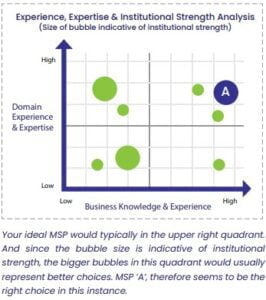
        Strong expertise, deep domain experience, institutional strength and scale, and proven reliability are your best guides here. Assess whether your workforce provider demonstrates strengths in these vital aspects.

        Une expertise solide, une expérience approfondie du domaine, une force institutionnelle et une envergure significative, ainsi qu’une fiabilité éprouvée sont vos meilleurs repères ici. Évaluez si votre fournisseur de main-d’œuvre démontre des points forts dans ces aspects essentiels.

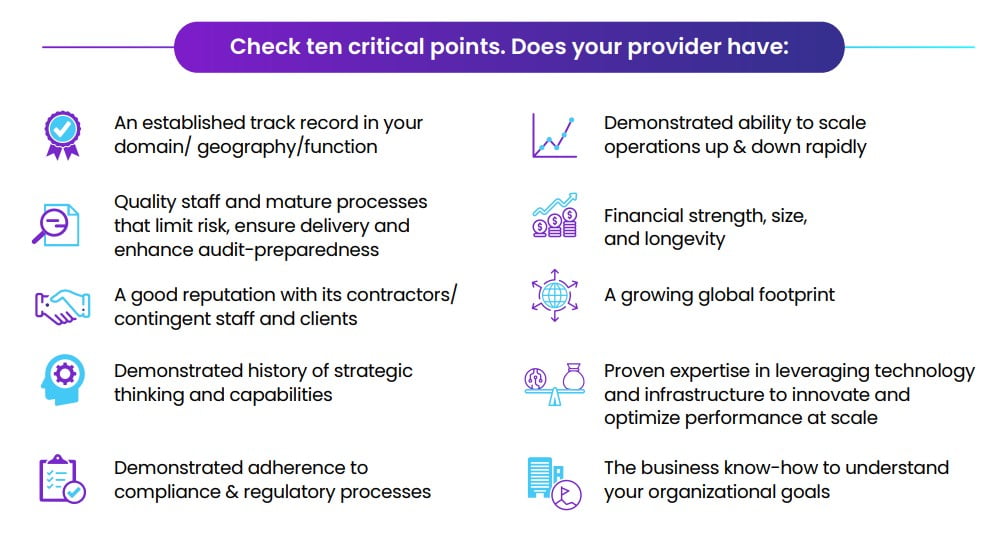
        10 Points to check for workforce provider

      2. Outcome-first approach

        Approche axée sur les résultats

        Traditional workforce solution providers focus on roles: “Whom are you looking to hire – backend engineer, data scientist, support desk staff …?”Les fournisseurs traditionnels de solutions de main-d’œuvre se concentrent sur les postes : « Qui cherchez-vous à embaucher – ingénieur backend, data scientist, personnel de support … ? »

        However, the ideal workforce partner puts outcomes first. The question becomes: “What is the outcome (or results) the business needs to achieve?”

        Cependant, le partenaire idéal met les résultats au premier plan. La question devient : « Quels sont les résultats que l’entreprise doit atteindre ? »

        Based on the answer, the ideal workforce partner objectively defines the skill sets required to achieve the desired outcome, creates a strategic plan to procure those skills, and ensures that the selected approach aligns with your broader organizational goals. Once outcomes are deconstructed in terms of the capabilities, your partner’s outcome focus enables it to move beyond the one person-one job model and implement a much more effective approach to workforce planning.

        Sur la base de cette réponse, le partenaire idéal définit objectivement les compétences nécessaires pour atteindre le résultat souhaité, élabore un plan stratégique pour acquérir ces compétences et s’assure que l’approche choisie est alignée sur vos objectifs organisationnels globaux. Une fois les résultats décomposés en termes de capacités, l’orientation vers les résultats de votre partenaire lui permet de dépasser le modèle « une personne – un poste » et de mettre en œuvre une approche beaucoup plus efficace de la planification de la main-d’œuvre.

    php-template
    Copy code

    1. Ability to curate & tap passive, active, and hidden talent

      Capacité à identifier et exploiter les talents passifs, actifs et cachés

      US CEOs ranked labor shortages as the number one external threat to business in 2022 in a survey carried out by the Conference Board at the beginning of the year. (Globally, it was placed in the number three slot). And while inflation has taken over the top spot since, talent shortage is still listed as one of the most significant challenges in most studies.Les PDG américains ont classé les pénuries de main-d’œuvre comme la menace externe numéro un pour les entreprises en 2022, selon une enquête menée par le Conference Board au début de l’année. (À l’échelle mondiale, elle était classée en troisième position). Et bien que l’inflation ait pris la première place depuis, la pénurie de talents reste l’un des défis les plus importants dans la plupart des études.

      The talent gap is even more pronounced in the tech world. The 85.2-million-open-tech-positions-by-2030 number has popped up on everyone’s newsfeeds by now. And even currently, studies show that 3 out of 4 companies face difficulties finding the tech talent they need to drive their business forward.

      L’écart de talents est encore plus prononcé dans le monde de la tech. Le chiffre de 85,2 millions de postes technologiques ouverts d’ici 2030 apparaît désormais dans tous les fils d’actualité. Même actuellement, les études montrent que 3 entreprises sur 4 rencontrent des difficultés pour trouver les talents technologiques nécessaires pour faire avancer leur activité.

      Given this backdrop, the ability to cultivate, curate and harvest talent pools becomes an essential qualifier for the ideal workforce partner.

      Dans ce contexte, la capacité à cultiver, sélectionner et exploiter les viviers de talents devient un critère essentiel pour le partenaire idéal en matière de main-d’œuvre.

      Typically, there are three talent pools recruiters can access.

      • Active – Les personnes en recherche active, prêtes à saisir leur prochaine grande opportunité
      • Passive – Les personnes qui ne consultent pas activement les offres d’emploi ou ne postulent pas aux opportunités publiées. Elles sont à l’aise dans leur poste actuel et auront besoin d’une raison convaincante pour changer.
      • Hidden – Ces candidats sont souvent écartés par l’IA. Souvent, leur CV présente des irrégularités – trou dans l’emploi, absence de diplôme, statut d’immigrant – ce qui les fait éliminer par l’algorithme, malgré leur adéquation au poste.

      While most workforce providers rely on active talent pools, your ideal partner should be able to leverage technology and human intelligence to tap the passive and hidden pools as well.

      Alors que la plupart des fournisseurs de main-d’œuvre s’appuient sur des viviers actifs, votre partenaire idéal devrait pouvoir exploiter la technologie et l’intelligence humaine pour accéder également aux viviers passifs et cachés.

      It should combine technology and manpower to reach and engage targeted talent… at scale… with high speed and efficiency.

      Il doit combiner technologie et main-d’œuvre pour atteindre et engager les talents ciblés… à grande échelle… avec rapidité et efficacité.

      In terms of tangible attributes, this translates into a partner who provides:

      • Dedicated recruiters focused on skill sets and geographical locations aligned to your specific needs.
      • Engagement with online niche communities and social media platforms to establish ongoing relationships with passive and active candidate pools
      • Access to an extensive database of curated candidate information, collected over the years, that is unique to the provider and gives ready access to a community of passive workers open to hearing about your opportunity.
      • Deep domain and skill-set expertise that allows them to leverage candidates across multiple assignments and clients
      • A digital approach that leverages best-in-class technology tools and data-driven strategy formulation to optimize workforce recruitment and candidate engagement. (Covered in detail in the next point)
      • Human intelligence to temper technology so that hidden pools are not overlooked.
  • Select Your Workforce Solutions Partner: 8 Key Pointers for Success

    Select Your Workforce Solutions Partner: 8 Key Pointers for Success

    Choosing Right Workforce Solutions Partner

    As we head into 2023, the talent shortages of this year have morphed the labor market into a real beast… a shapeshifter that requires constant reaction to the changing circumstances and proactive planning to achieve results.

    With businesses constantly planning and pivoting to stay ahead of disruptions, the demand for workers is shifting at a super-accelerated pace, not just in terms of numbers but also in terms of skill sets required and the budgets available.

    Yesterday’s headlines were about the Great Resignation; today, they are screaming about hiring freezes by the tech giants. CEOs cite worker shortages as a top concern, yet the economic downturn has them announcing layoffs. Reports of technology companies reducing headcount are interspersed with accounts of talent shortages as the most significant barrier to adoption of emerging technologies.

    The demands of the workforce are shifting too. Remote work, Gig economy, Quiet Quitting, the Great Renegotiation … a whole host of new terms have sprung up to reflect the changed aspirations of workers in a post-pandemic world.

    A strong, outcome-focused workforce partner is a critical asset for companies seeking solutions to handle this fluid backdrop – an ally who collaborates with the organization to plan, identify, procure, deploy, and engage resources required to get work done. A true partner, this workforce provider facilitates business agility by providing talent on demand and through delivery models customized to your evolving needs.

    Now, chances are you already have a workforce vendor in place.

    However, is your current provider adequately geared to partner with your organization in implementing operational, strategic, and tactical workforce planning in a post-pandemic world?

    Can it offer you the effective, flexible, and creative solutions required to redesign and rethink rapidly changing workforce requirements? Can it deliver the business agility you need? Can it reconfigure on demand … quickly and cost-effectively?


    The 8-Point Checklist For Choosing Ideal Workforce Solutions Partner

    Here is an 8-point checklist highlighting the attributes of the ideal workforce partner who can help you plan and pivot through all this turbulence and provide the real support you need to stay ahead of this tumultuous business environment.

    1. Expertise, Experience & Scale

      In a world where all workforce providers offer cookie-cutter options, you need to identify a partner with the muscle to deliver on their promises while remaining flexible enough to adapt to your ever-changing business needs.

      Strong expertise, deep domain experience, institutional strength and scale, and proven reliability are your best guides here. Assess whether your workforce provider demonstrates strengths in these vital aspects.

      10 Points to check for workforce provider

    2. Outcome-first approach

      Traditional workforce solution providers focus on roles: “Whom are you looking to hire – backend engineer, data scientist, support desk staff …?”

      However, the ideal workforce partner puts outcomes first. The question becomes: “What is the outcome (or results) the business needs to achieve?”

      Based on the answer, the ideal workforce partner objectively defines the skill sets required to achieve the desired outcome, creates a strategic plan to procure those skills, and ensures that the selected approach aligns with your broader organizational goals. Once outcomes are deconstructed in terms of the capabilities, your partner’s outcome focus enables it to move beyond the one person-one job model and implement a much more effective approach to workforce planning.

      Once outcomes are deconstructed in terms of the capabilities, your partner’s outcome focus enables it to move beyond the one person-one job model and implement a much more effective approach to workforce planning.

    3. Ability to curate & tap passive, active, and hidden talent

      US CEOs ranked labor shortages as the number one external threat to business in 2022 in a survey carried out by the Conference Board at the beginning of the year. (Globally, it was placed in the number three slot). And while inflation has taken over the top spot since, talent shortage is still listed as one of the most significant challenges in most studies.

      The talent gap is even more pronounced in the tech world. The 85.2-million-open-tech-positions-by-2030 number has popped up on everyone’s newsfeeds by now. And even currently, studies show that 3 out of 4 companies face difficulties finding the tech talent they need to drive their business forward.

      Given this backdrop, the ability to cultivate, curate and harvest talent pools becomes an essential qualifier for the ideal workforce partner.

      Typically, there are three talent pools recruiters can access.

      • Active
        The open-to-work status folks who are actively looking for their next great opportunity
      • Passive
        The people who are not actively looking at job postings or pursuing open advertised opportunities. They are comfortable in their current positions and will need a compelling reason to change.
      • Hidden
        These candidates tend to get screened out by AI. Often, these candidates have an irregular resume – a gap in employment, lack of college degree, immigrant status – which leads to the algorithm weeding them out, despite their suitability for the role.

      While most workforce providers rely on active talent pools, your ideal partner should be able to leverage technology and human intelligence to tap the passive and hidden pools as well.

      It should combine technology and manpower to reach and engage targeted talent… at scale… with high speed and efficiency.

      In terms of tangible attributes, this translates into a partner who provides:

      • Dedicated recruiters focused on skill sets and geographical locations aligned to your specific needs.
      • Engagement with online niche communities and social media platforms to establish ongoing relationships with passive and active candidate pools
      • Access to an extensive database of curated candidate information, collected over the years, that is unique to the provider and gives ready access to a community of passive workers open to hearing about your opportunity.
      • Deep domain and skill-set expertise that allows them to leverage candidates across multiple assignments and clients
      • A digital approach that leverages best-in-class technology tools and data-driven strategy formulation to optimize workforce recruitment and candidate engagement. (Covered in detail in the next point)
      • Human intelligence to temper technology so that hidden pools are not overlooked.
    4. Digital tools & technology wielded with human intelligence

      Digital tools & technology wielded with human intelligenceLike every other sector, the workforce domain, too, has seen huge technological innovation. Digital tools, data-driven models, AI-driven forecasting, cognitive automation … there is a mind-boggling array of choices out there.Most good workforce providers use these tools.The best workforce providers, though, leverage technology in combination with human intelligence to generate consistent, high-quality results. They are adept at aligning the right technologies at the right time to optimize their effectiveness.They have the expertise to assess which tools will benefit their clients most. Their technology stack is carefully assembled to provide effective results, visibility, service, and scale, while controlling operating costs.

      Let us consider an example where the provider leverages organizational expertise and a digital approach in tandem to elevate the workforce procurement process.

      Company A approaches the workforce provider to meet its demand to deliver certain business outcomes in a specific geography. The provider uses its expertise to translate the outcomes into skill sets, competencies, and prior experience to arrive at a fully developed workforce requirement.

      Requirement in place, the provider uses a data-driven approach to inform and guide its delivery plan. The organization’s internal data, collected over years of operation, and unique expert human insights are merged with 3rd party market data available via digital tools to understand aspects such as:

      • Competitive intensity for a particular job or skill
      • Employers in the local market competing for the same resource
      • Common attributes of potential candidates – wage, education, prior employers, and more
      • Skills, certifications, and even demographic profile data

      The provider’s expertise in the domain area then allows it to refine its search further, translating tasks required for the position into key competencies that can be demonstrated through experience obtained on prior jobs and identifying the companies where they may have utilized these skills recently.

      The result is a comprehensive sourcing strategy that generates qualified interest in your opportunity by targeting desired worker populations with messaging that promotes the benefits to the worker.

      An effective delivery approach emerges. If the target candidate profile is rated as a very-difficult-to-recruit, low- availability skill-set, the provider may recommend an accelerated, persuasive approach that targets passive and active candidates or even suggest flexible and remote working options to increase the size of the candidate pool.

      An intelligent, comprehensive technology stack equipped with critical capabilities – applicant tracking systems, 24×7 automated candidate harvesting technology, detailed process tracking and reporting capabilities, communication workflow systems – and established processes would be used to execute the delivery plan.

      Automated communications workflows, supplemented with direct human outreach and targeted campaigns by the provider’s talent management team, would be used to reach out to external candidates and potential targets within the provider’s internal system with great speed and efficiency.

      Objective technical and soft skill screening… both processes and tools… would be used to validate skills, and Subject Matter Experts would conduct professional interviews to validate soft skills and overall fit to your environment. Automated systems would track metrics, provide visibility, and maintain connection with the candidates at every stage, including post-recruitment.

    5. Comprehensive Offering, Workforce Engagement

      Comprehensive Offering, Workforce EngagementAs the example above illustrates, the ideal workforce partner should be a present and active participant throughout the journey from planning, to implementation, to engagement, to assessment – offering the right solutions to the right business challenges at the right time.

      So, assess if your workforce provider has the breadth of capabilities and competency to deliver a complete range of needed services that assist with each stage of workforce development.

      From market-informed planning and sourcing, through candidate engagement and selection, and continued care and support of the deployed worker while on assignment – a combination of technology and human interaction within a well-orchestrated framework is required to deliver a consistent and effective talent delivery program.

      Check the provider’s capability for every stage of the journey.

      When planning, does the provider undertake detailed demand analysis to anticipate your needs? Do they assess current labor market conditions, competitive pressures, and availability and cost of workers? With labor in short supply, especially within niche skillsets, and mounting mission-critical work waiting on the right worker to perform the tasks, predictable output from your workforce partner is critical to your business agility and meeting the demands of your customers. Validate your workforce partner’s process, frequency, information sources, and recommendations to ensure you will be ready and able to meet your business objectives.

      When it comes to sourcing and recruitment, as discussed earlier, you need to evaluate the provider’s ability to leverage tools, processes, technology, and human intelligence in tandem, to deliver optimum results quickly. Competition for workers has never been greater, so getting your opportunity presented to your ideal worker ahead of your competitors is vital to securing the worker and maintaining business agility.

      The best providers will have the means and methods to monitor and measure output… at each stage… to identify opportunities for spot corrections and ongoing continuous improvement.

      Post placement, your workforce partner needs to action constant, continuous contractor engagement to ensure that the talent they provide feels supported and cared for during the assignment and has a clear understanding of who their employer is.

      The ideal partner takes a comprehensive approach to delivering workforce engagement and contractor care. Healthcare benefits, online skilling and training opportunities, specialists to resolve worker questions and issues, and managed redeployment to their next assignment are just a few ways your workforce partner could provide workers with a career platform and stability while assigned to your company.

    6. Collaborative, Flexible, Scalable Solutions

      Does your provider work collaboratively with you to provide solutions customized to your specific needs?

      Most organizations offer value propositions that prioritize their existing products and services. However, a true workforce partner considers your inputs to construct delivery solutions that provide specific value exactly where you need it. It develops engagement models that align with your business rules and objectives and facilitates easy and timely interactions between 4required team members.

      What you need, how you need it, when you need it, and the metrics and SLAs used to evaluate outcomes … all key aspects must be defined collaboratively, in tune with your requirements, work environment, and business circumstances.

      And since flexibility and scalability are critical elements required to navigate the turbulent scenario today, check if the delivery model provides for rapid and easy change in scale and demand.

      The ability to ramp up to meet peak demand is as important to your business agility as the ability to deliver against typical volumes. Preserving consistency and service quality while quickly expanding to meet the growing demand is a vital consideration when selecting your workforce partner.

    7. Focused Delivery Model, Mature Governance & Transparency

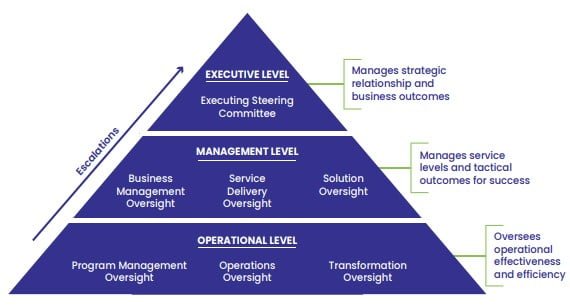
      To ensure that the promised services are delivered to the level required, an ideal workforce partner implements a holistic, multi-level delivery model that targets value creation across all three collaboration levels: planning, execution, and resources.

      At the planning level, the ideal workforce partner provides mature governance by deploying senior resources to steer and set strategic direction for the program. These resources, typically belonging to the executive management layer, have the business acumen and experience to understand client needs and desired outcomes. They are empowered to drive alignment of resources and support within their own organizations to meet client expectations without hesitation.

      Collaboration at the execution level entails working within program rules of engagement and compliance standards to provide the unique solutions and services required to accomplish your goals.

      From the initial intake of a particular job order… to coordinating selection activities… to managing back-office functions like Accounting and Human Resources, your workforce partner must have a seasoned, professional management team overseeing well-defined internal processes and methodologies that deliver predictable results in alignment with your organizational policies and objectives.

      Resources are the underlying layer that sets up the base for the planning and execution level collaboration. The quality of the people that will serve and advocate for your needs within the provider’s own organization is vital to delivery success. Also, the resources and tools they are provided to work with will impact the results they can deliver.

      So, assess if your workforce partner provides experienced, well-trained, customer-centric people working with state-of-the-industry processes and technologies. Understanding the provider’s people, culture, processes, methodologies, technologies, and tools upfront, will enable you to evaluate their potential as a workforce delivery partner for your organization.

      Continuous communication, full performance visibility, and ongoing course correction are other essential components of a mature governance structure. They should form the bedrock for both day-to-day interactions and delivery challenge scenarios.

    8. Diversity, Equity & Inclusion (DE&I) Focus

      Diversity, Equity & Inclusion (DE&I) FocusWhile most workforce providers recognize the need to deliver DE&I-focused solutions, often their efforts are superficial and lack truly impactful results – noble intentions reduced to mere platitudes.


      While most workforce providers recognize the need to deliver DE&I-focused solutions, often their efforts are superficial and lack truly impactful results – noble intentions reduced to mere platitudes.
      Where these efforts are deliberate and well-orchestrated, your provider should be able to provide data demonstrating their impact. To claim effectiveness, their results must beat the local labor market’s status quo, contributing more diverse candidates, as percentage of submittals and hires, than the local demographics for that particular skill/role. Reported EEO data, in summary form, is an excellent source of performance data in this regard.

      Providers whose workforce deployments consistently score higher than the market averages on the DE&I front are executing sourcing and recruiting strategies designed to better attract a full range of workers from all categories and reduce unconscious bias in their screening and candidate qualification activities.

      Important points to consider – Does your provider proffer DE&I delivery as a key performance metric? Is it strong only in certain areas, or does the workforce provided by it have representation across multiple diversity categories? Is diversity an organizing principle for the provider?

      And, most importantly, does your workforce partner walk that DE&I talk itself?

    Summary

    The workforce has changed and to remain agile, you and your workforce provider too must change. Eight key criteria can help you identify a strong workforce partner who can provide you effective solutions to stay ahead of the constantly shifting talent demand scenario.

    You need to assess if the workforce solutions provider:

    • Demonstrates adequate expertise, experience & scale
    • Follows an outcome-focused approach
    • Displays the ability to curate and tap passive, active, and hidden talent pools
    • Leverages digital tools & technology with human intelligence
    • Provides a comprehensive offering, complete with workforce engagement
    • Offers collaborative, flexible, scalable solutions
    • Follows a focused delivery model, and mature governance & transparency practices
    • Focuses on diversity, equity & inclusion

    Only if your workforce provider scores high on all these factors can it become a true partner that delivers the business agility you need.

    Discover Workforce Solutions from Artech

    From vision to delivery excellence, Artech Workforce Solutions enable clients across the globe to achieve the business outcomes they need intelligently.

    To know more about how our solutions can add value to your organization, write to us at nbd@artech.com

  • Choisir votre partenaire fournisseur de services gérés : 8 conseils clés pour réussir

    Choisir votre partenaire fournisseur de services gérés : 8 conseils clés pour réussir

    How to Choose Right MSP Partner

    Le marché des Managed Services est en plein essor. Et de quelle manière !

    Selon un rapport IDG publié en mars 2022, le marché mondial des Managed Services s’élevait à 239,71 milliards USD en 2021 et devrait enregistrer un taux de croissance annuel composé (CAGR) de 13,4 % entre 2022 et 2030.

    D’autres rapports projettent des tailles de marché et des taux de croissance différents. Cependant, le récit de base reste le même : à mesure que les entreprises prennent conscience que les Managed Services sont un outil essentiel pour naviguer dans des marchés complexes et imprévisibles, leur adoption est en hausse.

    L’attente est que le Managed Services Provider (MSP) vous fournisse un accès aux bonnes technologies, aux bons talents et aux bons processus de manière proactive, rapide et à des coûts raisonnables, vous permettant ainsi d’atteindre les résultats commerciaux dont vous avez besoin.

    Cependant, choisir le bon MSP pour votre organisation peut s’avérer délicat.

    Il existe une multitude de MSP, tous proposant ce qui semble être des offres et avantages standardisés. Et bien que les promesses soient audacieuses, la réalité est que beaucoup de fournisseurs ne tiennent pas leurs engagements. Ils assurent qu’ils travailleront comme de véritables partenaires, mais la plupart restent bloqués dans un mode fournisseur classique.

    Même si un MSP est performant, il n’est pas nécessairement aligné sur vos besoins organisationnels.

    Dans ce contexte, comment identifier le bon partenaire MSP ?


    8 Points Clés pour Sélectionner le Bon MSP

    Vous trouverez ci-dessous huit points clés qui caractérisent un bon MSP. Évaluer les fournisseurs potentiels selon ces critères vous aidera à sélectionner le MSP le mieux adapté à vos besoins.

    1. Expérience solide, expertise et force institutionnelle

      Le MSP que vous choisissez doit posséder une expérience approfondie et une expertise dans le domaine requis ; c’est le strict minimum.

      Seul un fournisseur doté de compétences fonctionnelles/techniques spécialisées et d’une exposition sectorielle pourra exploiter son expérience pour répondre efficacement à vos besoins.

      Outre l’expertise sectorielle, la connaissance des affaires et la capacité de réflexion stratégique sont également des caractéristiques essentielles.

      Contrairement à une agence d’externalisation traditionnelle qui se concentre sur la réalisation de tâches, le MSP est censé se concentrer sur le résultat commercial attendu.

      Il est donc crucial que votre fournisseur possède les connaissances commerciales nécessaires pour comprendre vos priorités et puisse collaborer non seulement à l’exécution des tâches mais aussi à la formulation de la stratégie. Vous avez besoin d’un fournisseur capable de s’asseoir avec la direction, de comprendre sa vision et ses objectifs, et de développer un plan pour les traduire en résultats.

      Pour vous assurer que le MSP que vous choisissez dispose d’un historique avéré d’expérience et d’expertise, utilisez la réputation et les références.

      Checklist Réputation & Références :

      • Références clients solides
      • Crédibilité auprès des régulateurs, superviseurs et fournisseurs
      • Démonstration de leadership éclairé dans le domaine
      • Historique de respect des réglementations sectorielles et fonctionnelles
      • Historique de pratiques exemplaires sectorielles
      • Démonstration de capacités de réflexion stratégique
      • Démonstration de savoir-faire commercial

      Expérience, expertise et force institutionnelle

      Une fois l’expertise et l’expérience établies, il faut évaluer la force institutionnelle, celle qui distingue un MSP d’exception.

      Évaluez le MSP sur les aspects de force institutionnelle tels que :

      • Longévité
      • Présence mondiale
      • Solidité financière et taille
      • Capacité à attirer des talents de qualité

      Un bon score dans ces domaines vous rassure sur le fait que le MSP est présent pour le long terme et dispose des moyens nécessaires pour investir dans l’infrastructure, la technologie, les talents et les processus dont vous avez besoin.

    2. Employés qualifiés, spécialisés et de longue durée ; effectifs adéquats

      Le MSP idéal vous donne accès aux compétences spécialisées dont vous avez besoin, au niveau requis, non seulement aujourd’hui mais aussi à l’avenir. Recherchez un fournisseur qui investit continuellement dans la formation et la mise à jour de ses employés.

      Évaluez également la capacité du MSP à attirer et à fidéliser les talents. Des employés de qualité, engagés sur le long terme et un faible taux de rotation garantissent un vivier de talents solide et la conservation du savoir-faire.

      Indicateurs de la capacité d’un MSP à attirer et fidéliser les talents :

      • Techniques rigoureuses pour identifier, recruter et maintenir les ressources
      • Approche disciplinée du développement et de la carrière des employés
      • Accent sur le développement des compétences, le coaching et le mentorat
      • Bonne réputation et forte image employeur
      • Rémunération compétitive complétée par des primes de performance

      Vérifiez également les niveaux de personnel proposés par le fournisseur. Des effectifs trop réduits limitent sa capacité d’innovation. Un MSP qui prévoit un certain excédent en matière de personnel a plus de marge pour proposer des idées et améliorer les performances.

    3. Support proactif, axé sur les résultats, et vision pour l’avenir

      La capacité à aller au-delà de la demande initiale est l’une des qualités essentielles d’un MSP idéal.

      Évaluez :

      • Le MSP a-t-il l’expertise et l’inclination pour détecter les vulnérabilités et opportunités de création de valeur ?
      • Le MSP est-il prêt à changer de cap pour fournir les résultats optimaux ?
      • Le MSP possède-t-il l’expérience nécessaire pour anticiper les problèmes avant qu’ils ne deviennent critiques ?
      • Le MSP peut-il identifier et réaliser des opportunités d’amélioration des performances dont vous n’êtes pas conscient ?

      Si le MSP répond positivement à tous ces points, c’est un partenaire à garder.

      Exemple : Shortcake à la fraise vs gâteau à la vanille

      Imaginez que vous organisez une fête et que vous souhaitez surprendre vos invités avec un dessert spécial. Vous optez pour un gâteau à la vanille. La fête a lieu, le gâteau est excellent et les invités l’apprécient.

      Dans un autre scénario, après vous avoir rencontré, le traiteur effectue quelques recherches et réalise que le shortcake à la fraise est plus tendance. Le chef pâtissier propose donc ce dessert, et les invités l’adorent.

      Cet exemple illustre parfaitement le support proactif, axé sur les résultats. Plutôt que de se limiter à un simple “gâteau à la vanille”, le fournisseur anticipe le résultat souhaité et propose la meilleure option en utilisant son expertise.

    4. Approche collaborative, flexible et innovante

      Que propose le MSP

      Flexibilité, agilité, évolutivité et innovation : la plupart des MSP mettent en avant ces atouts. Vérifiez si votre fournisseur peut réellement les livrer.

      • Propose-t-il des solutions personnalisées ?

        Évaluez si le MSP est capable d’adapter ses solutions à vos besoins spécifiques ou s’il reste figé sur ses technologies/processus habituels.
      • Propose-t-il un catalogue de services collaboratif et bien défini ?

        Le catalogue de services définit clairement les résultats attendus. Un MSP mature le construit avec vous, en tenant compte de vos préférences et indicateurs.
      • Offre-t-il une évolutivité ?

        Un bon MSP peut adapter ses services selon vos besoins, à tout moment.
      • Peut-il changer de cap pour atteindre l’objectif souhaité ?

        Vérifiez si le MSP est orienté résultats et ouvert à réévaluer ses tâches pour atteindre l’objectif final.
      • Propose-t-il des conditions tarifaires innovantes ?

        Certains MSP adoptent une tarification à la consommation et optimisent les coûts pour partager les gains avec leurs clients.
    5. Coopétition pour faciliter l’implication de plusieurs fournisseurs

      Coopétition = Collaboration + Compétition

      Le MSP idéal collabore avec d’autres fournisseurs, y compris ses concurrents, pour maximiser la valeur pour le client.

    6. Gouvernance mature, de la stratégie à l’exécution

      Recherchez un MSP avec une structure de gouvernance multi-niveaux (stratégique, tactique, opérationnel) permettant de suivre et corriger le projet en continu. Structure de l'équipe MSP
    7. VLAs, pas SLAs

      VLAs & SLAs Les VLAs (Value Level Agreements) relient la prestation de services aux résultats commerciaux souhaités, contrairement aux SLAs classiques basés sur l’exécution des tâches.
    8. Transparence et évaluation de l’adéquation

      La transparence sur la culture, les processus et la performance du MSP permet d’évaluer dès le départ la compatibilité avec votre organisation.

    Résumé

    Pour identifier le MSP le mieux adapté à vos besoins, évaluez s’il offre :

    1. Expérience solide, expertise et force institutionnelle
    2. Employés qualifiés, spécialisés, longue durée et effectifs adéquats
    3. Support proactif, axé sur les résultats et vision pour l’avenir
    4. Coopétition pour impliquer plusieurs fournisseurs
    5. Gouvernance mature, de la stratégie à l’exécution
    6. Approche collaborative, flexible et innovante
    7. VLAs, pas SLAs
    8. Transparence et évaluation de l’adéquation

    Découvrez les Managed Services d’Artech

    De la vision à l’excellence opérationnelle, les Managed Services d’Artech permettent aux clients du monde entier d’atteindre les résultats commerciaux souhaités, de manière intelligente.

    Pour savoir comment nos solutions peuvent apporter de la valeur à votre organisation, écrivez-nous à bruce.gerken@artech.com
    .

  • Selecting Your Managed Service Provider Partner: 8 Key Pointers for Success

    Selecting Your Managed Service Provider Partner: 8 Key Pointers for Success

    How to Choose Right MSP Partner

    The Managed Services market is booming. And how!

    As per an IDG report published in March 2022, the global Managed Services market stood at USD 239.71 billion in 2021 and is expected to clock a 13.4% growth rate (CAGR) from 2022 to 2030.

    Other reports project different market sizes and growth rates. However, the base narrative remains the same: As companies realize that Managed Services are an essential tool required to navigate today’s unpredictable, complex markets, adoption is on the rise.

    The expectation is that the Managed Services Provider (MSP) will provide you access to the right technology, talent, and processes proactively, quickly, and at cost-effective price points, enabling you to achieve the business outcomes you need.

    However, choosing the right MSP for your organization can be tricky.

    There is a plethora of MSPs out there, all of them offering what seem to be

    copy-paste service propositions and benefits. And while the claims are bold, the fact is that many providers fall short on the delivery front. They assure you that they will work as true partners, but in reality, most of them stay stuck in the trusted supplier mode.

    Also, even if an MSP is good, it might not necessarily be in sync with your organizational requirements.

    Given this landscape, how do you identify the right MSP partner?


    8 Key Pointers to Help You Select the Right MSP

    Listed below are eight key pointers that characterize a good MSP. Evaluating potential providers against these eight pointers can help you select the MSP best suited to meet your organizational needs.

    1. Strong Experience, Expertise & Institutional Strength

      The MSP you select needs in-depth experience and expertise in the required domain area; that’s the basic 101.

      Only if your provider is equipped with specialized functional/technical skills and industry exposure in the domain area, would it be able to leverage its experience to meet your requirements effectively.

      Along with domain expertise, business know-how and strategic-thinking abilities too are crucial qualifying characteristics for a good MSP.

      Unlike a traditional outsourcing agency that focuses on activity/task delivery, the MSP is expected to focus on the intended business outcome.

      Therefore, it is essential that your provider has the requisite business knowledge to understand your priorities and can partner not just in task execution, but also in strategy formulation. You need a provider that has the business know-how to sit down with the senior management team, understand their vision and objectives, and develop a plan to translate them into outcomes.

      To ensure that the MSP you select has a demonstrated history of experience and expertise, use the reputation and reference route.

      Reputation & Reference Checklist:

      • Strong client references
      • Credibility with regulators, supervisors, and vendors
      • Demonstration of thought leadership in the domain area
      • Track record of successful adherence to industry and function-specific regulatory updates
      • Track record of industry best practices driven level of effort
      • Demonstrated history of strategic-thinking capabilities
      • Demonstrated history of business know-how abilities

      Strong Experience, Expertise & Institutional StrengthDomain expertise and business experience established, you need to look for the third differentiator, institutional strength. This is the one that catapults the MSP into the ‘marry’ category.

      Evaluate the MSP on institutional strength areas such as;

      • Longevity
      • Global presence
      • Financial soundness & size
      • Ability to attract high-quality talent

      A strong score in these areas reassures you that the MSP is there for the long haul and has the muscle to invest in the infrastructure, technology, talent, and processes you need.

    2. Skilled, Specialized, Long-Tenure Employees; Adequate Staffing

      The ideal MSP provides you access to the specialized skill sets you need, at the level you need, not just today but in the future too. So look out for a provider that continuously invests in training and updating its employees.

      Another characteristic you need to assess is the MSP’s ability to attract and retain talent. Quality, long-term staff and low attrition rates translate into a strong talent pool and tenure efficiencies as knowledge is not lost in employee churn.

      Indicators of an MSP’s ability to attract and retain talent:

      • Well-defined, rigorous techniques used to identify, recruit, and maintain resources
      • Disciplined approach to employee career development and growth
      • Emphasis on skills development, coaching, and mentoring
      • Good reputation and strong employer branding
      • Best-in-class remuneration topped up with additional performance rewards

      Along with skilling, specialization, and tenure, check the staffing levels that the provider is proposing to complete the job.

      You don’t want an MSP that operates at bare minimum staffing levels. Sure, the job gets done, but the slim staffing levels don’t leave the MSP with any bandwidth to innovate.

      If your MSP builds in a cushion on the staffing front, it gives itself room to ideate, innovate, and recognize improvement opportunities for its clients.

    3. Proactive, Outcome-focused Support, and Forward Vision to Help You Future-Proof Your Business

      Willingness to look beyond the ask; this is one of the most critical, defining qualities of the ideal MSP.

      Willingness to look beyond the ask; this is one of the most critical, defining qualities of the ideal MSP.

      Evaluate:

      • Does the MSP have the expertise and inclination to constantly scout for vulnerabilities and value creation opportunities?
      • Is the MSP willing to shift track to deliver optimum outcomes?
      • Does the MSP have the expertise and experience required to get ahead of issues before they get out of hand?
      • Does the MSP have the skills and experience to identify and actualize performance improvement opportunities that you may be unaware of?

      If the MSP scores yes on all these counts, it is a keeper.

      Strawberry Shortcake Vs Vanilla Cake

      So, you are planning a party. You tell the catering team that you want to wow the guests with a special dessert. You decide that vanilla cake is a good option. The party happens. The caterers bake a brilliant vanilla cake. The guests quite like it.

      Now a slightly different scenario: After meeting you, the catering team goes back and does some homework. It realizes that vanilla cake is very last season. Strawberry shortcakes are the new in thing. So, the caterers suggest a menu change. Their pastry chef bakes a wonderful strawberry shortcake for your party. The guests love it. Wow factor established!

      The second scenario is an excellent example of proactive, outcome-focused support. Instead of fixating on the narrow deliverable of ‘Vanilla Cake’, the catering team focuses on the broader goal you want to achieve, “The Wow Factor”. It uses its expertise to identify a superior value option and leverages its in-house skills to deliver this option to you.

    4. Collaborative, Flexible, Innovative Approach

      What dose the MSP offer

      Flexibility, agility, scalability and innovation – most MSPs tout these benefits as their value proposition. Confirm whether your potential provider can deliver on these promises.

      • Is the MSP offering you customized solutions?

        Over time, an MSP develops comfort with certain products, processes, and technologies. It tends to leverage them when building solutions. And yes, the MSP’s experience and expertise in these areas yield you an advantage.

        However, is your MSP willing to invest time and effort in assessing the suitability of the technologies and processes vis-à-vis your requirements? Is the MSP product/process agnostic? Will it provide you a solution customized to your needs?

        If not, you should be looking elsewhere.

      • Is the MSP offering you a collaboratively developed, well-defined service catalog?

        The service catalog is the heart of a strong, turnkey Managed Service. This service catalog is a discrete way of defining the results you want to achieve. It lists the desired deliverables the MSP provides, along with the key differentiators such as service levels, complexity levels or any other methods you would like to differentiate essential outcomes. The catalog also specifies the standard costs associated with the service offers.

        A mature MSP would offer you a standard catalog of service that could be easily understood and consumed by your organization.

        But the MSP you want is the one that goes a step further.

        It would define the service catalog in collaboration with you. Customer preference, your preference, would be used to determine the offerings. The indicators used to qualify the service offerings would be developed collaboratively too.

      • Is the MSP offering you scalability?

        On the scalability front, a good MSP allows you to select the type and level of service you want.If your requirements change, will your MSP be able to scale up or down, providing you with all the services and support you need when you need them?

      • Is the MSP willing to shift track to achieve the desired outcome?

        The ideal MSP focuses on outcomes rather than narrow task/activity definitions. (Strawberry Shortcake vs Vanilla Cake)Do check if your MSP is committed to finding innovative, effective ways to improve performance. Ask the MSP if they are open to shifting track and redefining activities/ tasks to achieve the intended outcomes. Better still, see if they can provide you with client references for such instances.

      • Is the MSP offering you innovative pricing terms?

        Mature MSPs, the world over, are embracing the consumption-based pricing trend that allows you to pay for the Managed Services on an as-per-usage basis.However, some are going a step ahead; they are committing to optimizing cost structures and transferring some of the gains back to their clients.

        These providers are confident that they will be able to leverage multiple efficiencies – tenure efficiencies, capacity efficiencies, automation efficiencies, and functional efficiencies – to deliver great results at the best possible price.

        Partnering with such a provider puts you in a win-win situation. If there are savings, you share in them. If there is a miscalculation, the risk is on the MSP.

    5. Coopetition to facilitate multi-vendor involvement

      Coopetition = Collaboration + Competition

      The ideal MSP recognizes that it may need to work in coopetition with other vendors to achieve client objectives.

      These other vendors may well be the MSP’s competitors. However, instead of undermining them, a good provider focuses on working in partnership with the competition so that it can deliver higher value to the client. It realizes that the best way to get ahead of the competition is not to undermine others but to work more innovatively and collaboratively.

      Before signing on the dotted line, confirm if your MSP allows you the flexibility to bring in new vendors on an as-required basis without disrupting the existing service delivery relationship.

    6. Mature Program Governance, extending from strategy to execution

      Any managed service project entails a level of business transformation desired by the customer. Delivering this transformation, your intended business outcome, is not possible without a mature program governance structure.

      Look for an MSP whose team structure and governance allow it to operate at all operational, tactical, and strategic levels.

      MPS Team Structure

      This multi-level governance structure enables the provider to implement the managed service/task, continuously monitor it, and also make necessary course corrections as and when required.

      You are assured of alignment of goals at strategic levels, alignment of VLAs at tactical levels, and alignment of operating procedures at operational levels. Only when all three levels are in tandem will the MSP be able to deliver your business objective optimally.

    7. VLAs, not SLAs

      VLAs & SLAs

      As the maturity levels of outsourcing engagements advance, service level agreements too have started moving up the relevance path.

      Traditional SLAs focused on task/activity achievement parameters such as response and resolution times. However, good MSPs recognize that the achievement of such SLAs does not necessarily translate into desired outcome achievement.

      Therefore, they are moving towards the value level agreements (VLAs) model.

      VLAs link service delivery to desired business outcomes, which means MSP measures its results in terms of the value they have been able to create for their partner, you.

      YSince the desired outcomes would differ across engagements – enhanced customer experience, new functionality delivery, ability to adapt to change, increased process reliability – the VLAs would be defined as per your requirements.

      Has your preferred MSP demonstrated the ability to talk and negotiate VLAs? If not VLAs, is it at least discussing Value Level Objectives (VLOs)?

      The ability to set VLAs (or, failing that, VLOs) collaboratively with you signifies the expertise and maturity of the MSP. Also, when results are tracked in terms of value delivered, chances are that outcome achievement will improve.

    8. Transparency & Good-Fit Assessment

      Openness, accountability, and transparency are essential differentiators that set apart a good MSP.

      Not only does a mature, strong MSP have the experience and expertise to define fixed, clear cost structures and deliverables, it can also clearly outline its culture, processes, approaches, technology, and tools.

      This transparency enables you to make an upfront assessment of the fit between the MSP and your organization, an essential selection criterion given the partnership nature of Managed Services engagements.

      The ideal MSP is also transparent about its performance. Its offering would come complete with dashboards that allow you to track the service provider’s activities across the strategic, tactical and operational levels, ensuring you have visibility right from vision setting to actual delivery.

    Summary

    To identify the MSP best suited to meet your organizational needs and deliver required outcomes, you must keep eight key pointers in mind. You have to consider if the MSP offers you:

    1. Strong experience, expertise & institutional strength
    2. Skilled, specialized, long-tenured employees and adequate staffing levels
    3. Proactive, outcome-focused support, and forward vision to help you future-proof your business
    4. Coopetition to facilitate multi-vendor involvement
    5. Mature program governance structure, extending from strategy to execution
    6. Collaborative, flexible, innovative approach
    7. VLAs, not SLAs
    8. Transparency & good-fit assessment

    Discover Managed Services from Artech

    From vision to delivery excellence, Artech’s Managed Services are enabling clients across the globe to achieve the business outcomes they need, intelligently.

    To know more about how our solutions can add value to your organization, write to us at bruce.gerken@artech.com